What happens after a drug arrest in St Petersburg may depend on the booking allegation, custody status, bond decision, alleged substance, search circumstances, drug weight, laboratory testing, statements, and whether another warrant or probation hold affects release.
The arrest begins the case. It does not establish guilt, prove possession, or determine the final charge.
After booking, Pinellas County prosecutors may continue reviewing police reports, body-camera footage, search evidence, laboratory findings, statements, phone records, packaging, cash, witness accounts, and other information before deciding what offense to file.
A possession allegation may remain possession, be reduced, lead to no filing, or develop into allegations involving intent to sell, delivery, trafficking, paraphernalia, weapons, or additional controlled substances.
While the evidence is still being reviewed, the person may already be sitting in jail, missing work, trying to protect family stability, and wondering whether the charge listed during booking is only the beginning.
Florida Criminal Defense Command Center Briefing
Case File Status
Updated St Petersburg Drug Arrest Case File
Investigation Location
St Petersburg and Pinellas County, Florida
Primary Question
What happens after a drug arrest in St Petersburg, and how may booking, bond, searches, laboratory testing, alleged possession, and prosecutorial review affect what happens next?
Florida Investigation Snapshot
A St Petersburg drug arrest may begin several investigations at once:
Arrest and transport
Pinellas County booking
Bond or detention review
First appearance when required
Review of warrants and other holds
Inventory and preservation of seized evidence
Laboratory testing of the alleged substance
Review of the search and alleged possession
Continued investigation of phones, vehicles, cash, witnesses, or property
Prosecutorial charging review
Arraignment and later pretrial proceedings
The charge entered during booking is not necessarily the charge ultimately filed in court.
Drug identity, alleged weight, search evidence, prescription records, witness statements, phone evidence, packaging, cash, and other investigative findings may change how the case is charged.
Educational Promise
This Case File explains what may happen after a St Petersburg drug arrest, from transport and Pinellas County booking through bond, custody, laboratory testing, possession disputes, charging review, evidence preservation, and the next court proceedings.
Florida Investigation Roadmap
This investigation examines:
Booking, bond, holds, and first appearance
Whether the arrest charge may change
What evidence Pinellas County prosecutors review
How vehicle, residence, hotel, and container searches affect the case
Actual and constructive possession
Laboratory identity, chain of custody, and drug weight
Intent-to-sell and trafficking allegations
Seized phones, cash, vehicles, and property
Probation and pretrial-release consequences
Evidence preservation, arraignment, and the next court proceedings
Review a St Petersburg Drug Arrest
A St Petersburg drug arrest creates immediate questions about release, the search, alleged possession, seized property, and what prosecutors may charge. The arrest paperwork and available evidence can help identify which issues need attention first.
The Florida Criminal Defense Command Center may connect you with an independent licensed Florida criminal defense attorney, depending on the circumstances and attorney availability. You do not need laboratory results or a complete court file before requesting a connection.
A drug arrest may begin both a custody process and a continuing evidence investigation.
The immediate sequence may involve:
Arrest and transport
Booking into the Pinellas County Jail
Review of the alleged charges
Identification of bond, warrants, and other holds
First appearance or another release review
Inventory and preservation of seized property
Laboratory testing of the alleged substance
Review of the search and possession evidence
A prosecutorial filing decision
Arraignment and later pretrial proceedings
These stages do not always occur in a simple order.
While the person and family are focused on release, law enforcement or prosecutors may still be examining:
Where the alleged drugs were found
Who controlled the location
Whether the area was shared
Whether a warrant or consent was used
What the substance allegedly was
How much it allegedly weighed
Whether a prescription existed
What statements were made
Whether cash, packaging, scales, weapons, or phones were seized
Whether another person may have possessed the substance
The first crisis may be getting out of jail. The larger investigation is often determining what the drug allegation becomes after the evidence is tested and reviewed.
That leads to the first immediate question: where is the person taken, and what happens before release can be considered?
Where Is Someone Taken After a St Petersburg Drug Arrest
A person arrested in St Petersburg may remain briefly in the custody of the arresting agency before being transported for booking into the Pinellas County Jail.
The arresting agency may include:
St Petersburg Police Department
Pinellas County Sheriff’s Office
Another local law enforcement agency
A state agency
A joint investigative unit
Another agency executing an outstanding warrant
The location of the arrest does not always identify which agency investigated the alleged drug offense or seized the evidence.
Before booking, officers may:
Confirm identity
Review outstanding warrants
Record the alleged offenses
Secure seized evidence
Inventory property
Arrange transportation
Document statements
Complete arrest paperwork
Communicate with jail personnel
The person should not assume that an explanation given during transport or processing is outside the investigation.
Statements about ownership, knowledge, where the drugs came from, who controlled a vehicle or room, or whether another person was involved may later appear in police reports or court proceedings.
The guide to St Petersburg arrest procedures follows transport, booking, bond entries, outstanding warrants, and early court review.
Once the person reaches the jail, the investigation moves into booking, custody classification, and release review.
What Happens During Pinellas County Booking After a Drug Arrest
Booking creates the formal custody record for the arrest.
The process may include:
Confirming identity
Photographing and fingerprinting
Recording the arresting agency
Entering the alleged charges
Reviewing outstanding warrants
Identifying probation or community control status
Listing bond information
Recording no-bond or detention instructions
Inventorying money and personal property
Conducting medical screening
Assigning a booking number
Processing the person into housing or release procedures
What Drug Information May Appear During Booking
The booking record may identify:
The alleged controlled substance
Possession
Possession with intent to sell
Sale or delivery
Trafficking
Drug paraphernalia
Multiple drug counts
Weapons or resisting allegations
A probation or pretrial-release violation
Other charges arising from the same encounter
The booking entry reflects the allegation at that stage.
It does not necessarily establish:
The final chemical identity of the substance
The final laboratory weight
Who legally possessed it
Whether the search was lawful
Whether intent to sell can be proven
Whether trafficking thresholds apply
What charges prosecutors will ultimately file
What Happens to Cash and Personal Property During Booking
Cash and personal property may be inventoried when the person is booked into the Pinellas County Jail.
The booking record or property receipt may identify items such as:
Cash
Phones
Keys
Wallets
Identification
Jewelry
Medication
Documents
Other personal belongings
Some property may remain with the jail for safekeeping. Other items may be retained as evidence or become part of a separate seizure or forfeiture issue.
The booking inventory may not include everything taken during the arrest. Property seized from a vehicle, residence, hotel room, bag, or another location may appear in separate police or evidence records.
Can Booking Statements Affect a St Petersburg Drug Case
Potentially.
Statements made during transport, booking, or related processing may later become part of the investigation.
Those statements may involve:
Ownership of the alleged drugs
Knowledge of the substance
Control of a vehicle, room, bag, or container
Prescription medication
Cash or packaging
Another person’s involvement
Drug use
Probation status
Residence information
Ownership of a phone or other property
A brief attempt to explain the situation may later be characterized as an admission.
Whether a statement may be used can depend on the precise words, surrounding questions, whether the statement was voluntary, whether officers engaged in custodial interrogation, and whether any legally required warnings were provided.
Routine identification questions and investigative questions designed to obtain incriminating information do not necessarily present the same legal issue. Body-camera footage, booking recordings, written reports, and witness testimony may help establish what was asked and what was actually said.
The next immediate question is whether the person can be released and what controls the bond decision.
How Is Bond Decided After a St Petersburg Drug Arrest
Bond after a St Petersburg drug arrest may depend on the alleged offense, criminal history, release status, other warrants, community ties, and whether the State seeks detention or additional conditions.
The court may review:
The booking allegations
Whether the offense is a misdemeanor or felony
The alleged controlled substance
The alleged drug weight
Whether trafficking is alleged
Whether weapons were involved
Criminal history
Prior failures to appear
Employment
Length of residence
Family and community ties
Probation or community control status
Whether the person was already on pretrial release
Other warrants or holds
Public-safety allegations
The likelihood of appearing in court
Can Someone Bond Out Before First Appearance
Potentially.
Release may depend on the charge, bond schedule, release eligibility, other holds, and whether judicial review is required.
A listed bond does not always mean the person can immediately leave the jail.
Release may still be prevented by:
A probation or community control hold
Existing pretrial-release status
Another warrant
A detention request
A no-bond instruction
A court order requiring first-appearance review
Can the State Request Pretrial Detention
Yes, when a statutory ground applies and the required procedures and findings are satisfied. A detention request asks the court to keep the accused in custody while the criminal case is pending.
Florida law includes a trafficking-specific detention ground involving a substantial probability that the accused committed the offense and a finding that release conditions will not reasonably assure appearance at later proceedings.
The statute also classifies certain drug offenses as dangerous crimes, including unlawful manufacturing and the trafficking offense identified in section 893.135(1)(c)4. Qualifying dangerous crimes may trigger mandatory detention-motion procedures depending on the degree of the offense.
A required motion is not the same as an automatic detention order. The court must apply the governing standards and make the findings required for the applicable detention ground.
The review should identify:
The findings supporting any detention order
The precise charge and statutory subsection
The asserted detention ground
Whether the required motion and hearing procedures were followed
The evidence supporting the allegation
Relevant criminal and court history
Whether release conditions could address the legally relevant concerns
What Release Conditions May Be Imposed
Release may involve more than paying a monetary bond.
Possible conditions may include:
Appearing at all required court dates
Avoiding new criminal activity
Pretrial supervision
Drug testing
Substance-use treatment
Travel restrictions
Electronic monitoring
Surrendering a passport
Restrictions involving weapons
Other conditions ordered by the court
The written release order should be reviewed carefully.
Violating a material condition may create a separate risk of release revocation, detention, or another criminal allegation.
The Case File on St Petersburg bond decisions examines the alleged offense, court history, existing supervision, community ties, detention requests, and proposed release conditions.
A bond amount is only one part of the custody picture.
The next section explains why someone may remain in the Pinellas County Jail even when a monetary bond appears beside the drug charge.
Why Someone May Remain in the Pinellas County Jail After Bond Is Listed
A bond amount beside the drug charge does not always mean the person can leave the Pinellas County Jail.
Another warrant, hold, court order, or release restriction may keep the person in custody even after the listed bond is posted.
Possible reasons include:
A probation or community control warrant
A no-bond probation hold
Another pending criminal case
Revoked pretrial release
An outside county warrant
An out-of-state detainer
A pretrial detention request
A charge requiring judicial review
Release processing that has not been completed
The jail record may contain separate custody instructions for each case.
A person may have bond on the new drug charge but remain jailed because another hold has not been resolved.
Posting one bond addresses only the charge connected to that bond. It does not remove every legal reason for continued custody.
For families waiting for release, this is often one of the most confusing parts of the process. The visible bond may appear to be the final obstacle while another warrant or court order remains in place.
The investigation into custody after St Petersburg arrests examines separate warrants, probation holds, court orders, and release processing that may affect time spent in jail.
The next question is what happens when the person first appears before a Pinellas County judge.
What Happens at First Appearance After a St Petersburg Drug Arrest
Unless previously released in a lawful manner, an arrested person generally must be taken before a judicial officer within 24 hours. At first appearance, the judge may advise the accused of the allegation and relevant rights, address representation by counsel, review probable cause when required, and determine release or detention under the controlling law and court rules.
The court may address:
The alleged drug charge
Whether the arrest affidavit supports probable cause
Appointment or recognition of counsel
Bond
Release conditions
A request for pretrial detention
Probation or community control status
Other warrants or holds
The next court date
First appearance is not a trial or a final ruling on guilt. The judge may examine the alleged possession, search circumstances, and other evidence for preliminary purposes, including probable cause and release. Contested suppression questions and whether the State can prove the filed charge ordinarily require later proceedings.
Those questions may depend on later review of:
Police reports
Body-camera footage
Search-warrant materials
Laboratory evidence
Witness statements
Phone records
Prescription documentation
Defense evidence
The guide to St Petersburg first appearances explains the initial review of rights, counsel, applicable probable-cause questions, bond, detention requests, and separate holds.
Does the Judge Decide the Final Drug Charge at First Appearance
Not usually.
The court may review the allegation presented by law enforcement for probable-cause and release purposes.
Pinellas County prosecutors may still change the formal charge after reviewing:
Laboratory results
Drug identity
Alleged weight
Search evidence
Packaging
Cash
Scales
Phone evidence
Statements
Prescription records
Additional investigative reports
The charge discussed at first appearance may therefore differ from the offense later filed.
Can Bond Change at First Appearance
Potentially.
The judge may:
Leave the existing bond in place
Increase or reduce the bond
Add release conditions
Order pretrial supervision
Require drug testing
Impose travel restrictions
Address a detention request
Continue a legally authorized hold
The decision may depend on the alleged offense, criminal history, prior court appearances, release status, community ties, danger allegations, and other pending cases.
Can a Probation Hold Be Resolved at First Appearance
Not always.
A first-appearance judge may address the new drug arrest while another judge or court controls the probation violation.
The person may receive bond on the new charge and remain jailed because the probation hold must be addressed separately.
The drug case and probation case may proceed under different case numbers, judges, evidence standards, and hearing schedules.
Once custody and release are addressed, the investigation turns to a question many people misunderstand:
Is the drug charge listed during booking the charge prosecutors will actually pursue?
Is the Booking Charge the Final Drug Charge in Pinellas County
Not necessarily.
The booking charge usually reflects the arresting officer’s allegation based on the information available at that time.
The formal filing decision may change after prosecutors review the full investigation.
The charge may:
Remain the same
Be reduced
Be increased
Be separated into multiple counts
Be changed to another drug offense
Include additional allegations
Be declined on one or more counts
Remain under investigation
A person arrested for possession may later face allegations involving:
Felony possession
Possession with intent to sell
Sale or delivery
Drug trafficking
Multiple controlled substances
Drug paraphernalia
Weapons
Resisting
Prescription-drug offenses
A probation violation
The booking label does not establish what prosecutors can prove.
Why a St Petersburg Drug Charge May Change After Arrest
The filing decision may be affected by:
Laboratory identification
Confirmed drug weight
Multiple substances
Packaging
Scales
Cash
Text messages
Payment applications
Surveillance
Witness statements
Search-warrant evidence
Statements attributed to the accused
Prescription records
Additional police investigation
A substance believed to be one drug at arrest may later test differently.
An estimated weight may change after laboratory processing.
Evidence found on a phone, in a vehicle, or at another location may create additional allegations.
Evidence showing shared access, lawful prescription possession, weak identification, or an unreliable search may point in the opposite direction.
The booking charge begins the charging investigation. It does not finish it.
The next section examines the evidence prosecutors may review before deciding what to file.
What Evidence Do Pinellas County Prosecutors Review After a Drug Arrest
Pinellas County prosecutors may review the arrest report and supporting evidence before deciding whether to file the same charge, a different charge, additional counts, or no charge on one or more allegations.
The review may include:
Arrest affidavits
Police reports
Body-camera footage
Dash-camera footage
Search-warrant materials
Surveillance video
Witness statements
Photographs
Seized substances
Laboratory reports
Chain-of-custody records
Phone evidence
Financial records
Prescription records
Statements attributed to the accused
Evidence involving other people
The prosecutor may examine:
Why the police encounter began
Whether a warrant was used
Whether consent was claimed
Where the alleged drugs were found
Who controlled the location
Whether the area was shared
What laboratory testing identified
What the confirmed weight was
Whether a valid prescription existed
Whether messages or records suggest sale or delivery
Whether witnesses are available
Whether the evidence supports the arrest allegation
The guide to Florida criminal charging evidence explains how prosecutors assess investigative reports, statements, recordings, physical evidence, and the legal elements of a potential charge.
Does the Arrest Affidavit Control the Drug Filing Decision
No.
The arrest affidavit presents the officer’s account of what happened and why the arrest occurred.
It may describe:
Where the alleged drugs were found
Why the stop or search began
Statements
Field-test results
Packaging
Cash
Scales
Witness accounts
The officer’s theory of possession
The prosecutor may compare that account with:
Body-camera footage
Laboratory findings
Search records
Dispatch information
Witness statements
Property receipts
Phone evidence
Prescription documentation
Other investigative materials
Conflicts between the affidavit and later evidence may affect what charge is filed and how the case proceeds.
Can Packaging Cash or Scales Increase a St Petersburg Drug Charge
Potentially.
Pinellas County prosecutors may treat packaging, cash, scales, or evidence of repeated transactions as support for an allegation involving possession with intent to sell or delivery.
These facts do not automatically prove drug sales.
Cash may have a lawful source. A scale may have another use. Packaging may belong to someone else or be unrelated to the alleged substance.
The evidence must still be authentic, lawfully obtained, connected to the accused, and relevant to the charge prosecutors decide to file.
Can Witness Statements Affect a St Petersburg Drug Charge
Yes.
Witnesses may include:
Passengers
Drivers
Residents
Hotel guests
Property owners
Informants
Alleged buyers or sellers
Neighbors
Police officers
Other people present during the search
The prosecutor may examine whether the witness:
Personally observed the conduct
Had access to the location
Claimed ownership
Made inconsistent statements
Received a benefit
Had a reason to shift responsibility
Can reliably identify the accused
Is supported or contradicted by other evidence
One person’s accusation may begin the investigation without resolving credibility, motive, access, or possession.
Can a St Petersburg Drug Investigation Continue After Release
Yes.
Release from jail does not necessarily end the investigation.
Law enforcement or prosecutors may continue reviewing:
Laboratory results
Phone extraction
Search-warrant evidence
Vehicle records
Surveillance
Financial information
Witness statements
Prescription records
Evidence involving codefendants
Additional alleged transactions
The person may be home, back at work, or caring for family while the State is still deciding what the arrest will become.
During that period, evidence may disappear, witnesses may become harder to locate, and release conditions remain enforceable.
That is why early review may matter before the charging decision is complete.
The next sections examine search authority and the evidence needed to connect the accused to the substance.
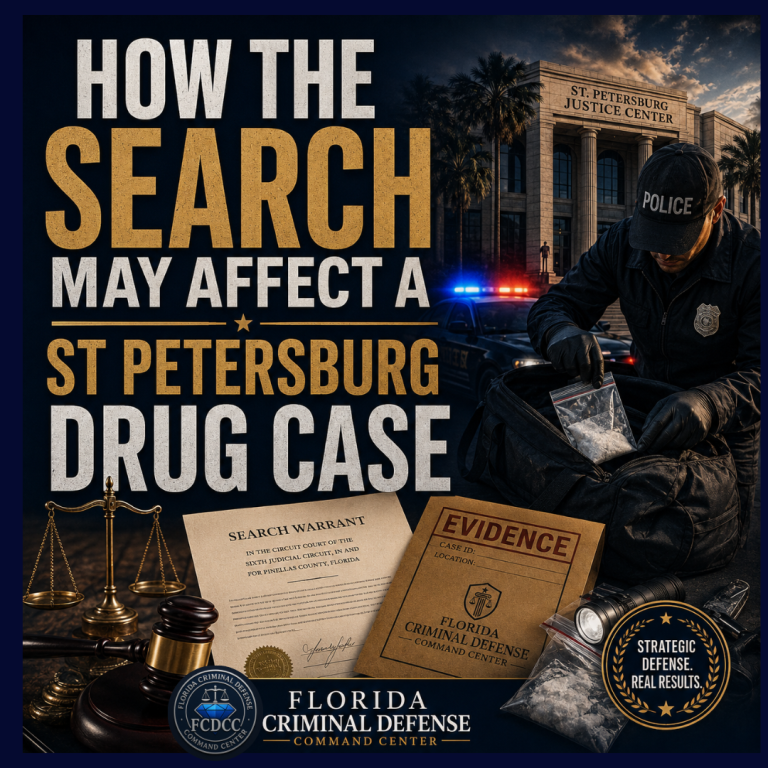
How the Search May Affect a St Petersburg Drug Case
A St Petersburg drug case may depend on more than what police claim they found.
The investigation may also examine how officers entered the vehicle, home, hotel room, bag, or other location where the evidence was discovered.
Important questions may include:
Why did the police encounter begin?
Did officers have a warrant?
Was consent requested or claimed?
Who gave consent?
Did that person control the location?
What areas were officers allowed to search?
Did the search exceed that authority?
What does body-camera footage show?
Where exactly was the substance found?
Who could access that location?
A search may uncover suspected drugs without proving who knowingly possessed them.
The investigation therefore asks two separate questions:
Was the evidence lawfully obtained?
Can the evidence be connected to the accused?
The answer often begins with where the substance was found.
What Happens When Drugs Are Found in a St Petersburg Vehicle
A vehicle drug arrest may begin with a traffic stop, a warrant, claimed consent, probable cause, or another asserted legal basis.
The investigation may examine:
Why the vehicle was stopped
Who owned and drove it
Where each person was seated
What officers knew before the search
Whether consent was given
Where the substance was found
Whether it was visible or concealed
Whether it was inside a bag or container
Who owned or used that container
Whether body-camera footage matches the report
The location matters.
Drugs found in a driver’s pocket create a different case from drugs found under a passenger seat, inside a shared console, in the trunk, or in property belonging to someone else.
The Case File on St Petersburg vehicle searches examines the stop, length of detention, claimed consent, probable cause, container searches, and recorded police conduct.
Are All Vehicle Occupants Charged With Drug Possession
Not automatically.
Presence inside a vehicle does not by itself establish knowledge or control.
Prosecutors may look for additional evidence such as:
Statements
Personal belongings
Vehicle ownership
Exclusive access
Fingerprints or DNA
Phone evidence
Witness testimony
A claim of ownership
Conduct observed by officers
For someone arrested while riding in another person’s vehicle, the difference between presence and possession may determine the entire case.
That same issue becomes even more complicated inside a shared residence.
What Happens When Drugs Are Found in a Home or Shared Residence
A home search may involve a warrant, claimed consent, an arrest, or another asserted basis for entry.
The investigation may review:
Who owned or rented the residence
Who lived there
Who had keys
Which room was searched
Whether the space was private or shared
Where the substance was found
Whether it was hidden
Whose belongings were nearby
Whether other people had access
Whether anyone claimed ownership
Whether the search stayed within its lawful scope
Living in a residence does not establish possession of every item found inside it.
Drugs found in a locked bedroom beside identification may create a different record from drugs found in a shared kitchen, garage, bathroom, or living room.
The guide to St Petersburg search warrants examines supporting affidavits, authorized locations and items, limits on the search, and issues that may support a suppression request.
What If the Drugs Were Found in a Shared Bedroom
A shared bedroom may contain clothing, furniture, drawers, bags, and containers used by more than one person.
The location of the substance, nearby belongings, access to the container, statements, and evidence identifying an owner may all matter.
Personal property near the substance may strengthen the State’s theory. The connection may remain disputed when the room was shared, another person had equal access, or the evidence was found inside property controlled by someone else.
What Happens When Drugs Are Found in a Bag or Container
A bag, backpack, purse, suitcase, or box may become central to the possession allegation.
The investigation may ask:
Who owned it
Who carried it
Where it was found
Whether it contained identification
What other property was inside
Whether it was open, closed, or locked
Who could access it
Whether another person used it
Whether anyone claimed ownership
Whether fingerprints, DNA, messages, or video exist
A container carried directly by the accused presents a different case from one found in a shared vehicle, residence, or hotel room.
Even then, questions may remain about knowledge, ownership, who placed the substance inside, and whether the search was lawful.
What Happens When Drugs Are Found in a St Petersburg Hotel Room
A hotel-room drug arrest may involve visitors, shared luggage, short-term access, and uncertainty about who controlled particular areas.
The investigation may examine:
Who rented and paid for the room
Who possessed a key
Who was registered
Who was present
How long each person had been there
Where the substance was found
Whether luggage identified an owner
Whether officers used a warrant or claimed consent
Whether surveillance or key-card records exist
Whether anyone entered or left before the arrest
Being present in a hotel room does not establish possession of every item inside it.
Registration records, surveillance, receipts, messages, luggage, witness accounts, and key-card data may support or challenge who had knowledge and control.
That leads to the central question in every shared-location drug case: what does possession actually require?
What Actual Possession Means in a St Petersburg Drug Case
Actual possession may involve a substance in someone’s hand, on the person, or in a container carried by that person. It may also involve a substance within ready reach and under the person’s control. Nearness alone does not establish possession.
Examples may include suspected drugs found:
In a pocket
In a hand
Inside clothing
In a bag being carried
Within ready reach when the evidence also establishes control
The State must establish the knowledge and control required by the charged offense. The location of the substance does not automatically resolve whether the person knew it was present, whether lawful authorization existed, or whether the search and identification evidence are reliable.
Ownership and possession are different. A person can knowingly possess a substance that belongs to someone else. Saying “it was not mine” does not, by itself, resolve a possession allegation.
What Constructive Possession Means After a St Petersburg Drug Arrest
Constructive possession may be alleged when the substance was not in the accused person’s hand, clothing, carried container, or immediate physical control.
To establish constructive possession, the State generally must prove that the accused knew the substance was present and had the ability to exercise dominion and control over it.
Those elements become especially important when drugs are found in a shared vehicle, residence, hotel room, common area, or container. Joint occupancy alone does not establish that each occupant knew about and controlled the substance. The State must present evidence establishing the accused person’s knowledge and control rather than rely solely on presence or proximity.
Possession can be joint, meaning more than one person may knowingly exercise control. Shared occupancy does not automatically establish joint possession.
Ownership records, exclusive access, personal belongings, statements, fingerprints, DNA, phone evidence, witness testimony, and the conduct of other people may strengthen or weaken the claimed connection.
The investigation may focus on:
Knowledge that the substance was present
Ability to control it
Ownership or control of the location
Exclusive or shared access
Statements
Personal belongings
Fingerprints or DNA
Phone evidence
Witness testimony
The conduct of other people present
Constructive possession often becomes central when evidence is found in:
A shared vehicle
A shared residence
A hotel room
A common area
A bag used by more than one person
Property owned by someone else
The guide to constructive possession in Florida examines knowledge, control, shared access, personal belongings, statements, and other evidence when drugs are found outside someone’s immediate possession.
Does Knowledge of the Substance’s Illicit Nature Matter
Yes, but Florida law treats that issue differently from knowledge that the substance was physically present.
The State must establish the possession elements required by the charged offense. Under Florida Statute §893.101, lack of knowledge of the illicit nature of the substance is an affirmative defense rather than an element the State must initially prove.
When that defense is properly raised, actual or constructive possession creates a permissive—not mandatory—presumption that the accused knew the substance’s illicit nature.
This issue should not be confused with whether the accused knew the substance was present or had the ability to control it. Those remain central questions in a constructive-possession case.
Does Proximity Alone Prove Drug Possession in Pinellas County
No. Proximity alone does not establish the knowledge and control required for possession.
A person may be near suspected drugs without knowing they are present or having the ability to control them.
The investigation may examine:
Whether the location was shared
Whether the substance was visible or hidden
Whether the accused had exclusive access
Whether another person had equal access
Whether personal property connected the accused to the evidence
Whether anyone made an admission
Whether witnesses are reliable
Whether electronic evidence supports the allegation
Whether officers relied mainly on presence
For someone arrested in another person’s vehicle, home, or hotel room, this may become the defining issue.
Presence explains where someone was. It does not automatically prove what that person knew or controlled.
Can Another Person’s Statement Shift the Possession Allegation
Yes.
Another person may:
Claim ownership
Deny ownership
Blame the accused
Change the account
Control the location or container
Expect favorable treatment
Attempt to avoid responsibility
The investigation may ask:
Did the person actually know who owned the substance?
Was the statement recorded?
Did the account remain consistent?
Was the witness also facing arrest or charges?
Was any benefit offered or expected?
Does physical evidence support the accusation?
Did the witness have a reason to shift blame?
What do video, messages, or other records show?
One accusation may influence an arrest without resolving credibility, motive, access, or control.
What Evidence May Support or Challenge Constructive Possession
The State may rely on several facts together rather than one fact alone.
Evidence may include:
Keys
Mail
Identification
Clothing
Fingerprints
DNA
Text messages
Photographs
Location records
Vehicle registration
Lease or ownership records
Hotel records
Witness testimony
Statements
Surveillance
Evidence of exclusive access
The same evidence may support different explanations.
A key may prove access without proving knowledge of everything inside.
Mail may connect someone to an address without connecting that person to a particular room, drawer, or container.
A message may appear incriminating when separated from the full conversation.
Personal property near the substance may suggest ownership, but the complete location and access history still matter.
Why Search and Possession Must Be Reviewed Together
The search explains how police obtained the evidence.
The possession investigation asks whether that evidence can be connected to the accused.
A lawful search does not automatically prove possession.
A possession theory does not automatically make the search lawful.
Both questions may affect what happens next:
Was the evidence lawfully discovered and seized?
Can the State prove the accused knew about it and could control it?
Body-camera footage, warrant materials, ownership records, statements, witness credibility, personal property, access, and the exact location of the substance may all matter.
A person should not carry the weight of every item found in a shared space merely because police made an arrest.
The next phase examines what the substance actually was, how it was tested, how much it weighed, and whether laboratory findings may change the charge.
Why Laboratory Testing Matters After a St Petersburg Drug Arrest
A St Petersburg drug arrest may begin with an officer’s description, packaging, or field-test result.
The final charge may depend on what laboratory testing later identifies.
Testing may determine:
Whether the evidence contains a controlled substance
What substance was identified
Whether more than one substance is present
The tested weight
Whether the result matches the arrest allegation
Whether additional analysis is required
A laboratory result may strengthen the allegation.
It may also identify a different substance, report a lower weight, or fail to confirm a controlled substance in the tested evidence.
Testing may change the charging assessment, but prosecutors do not necessarily have to wait for a completed laboratory report before filing a charge. Substance identity may sometimes be established through other legally sufficient evidence. Whether that evidence is adequate depends on the substance, the witnesses, and the circumstances.
Does a Field Test Prove a St Petersburg Drug Charge
Not by itself.
A reported field-test result may contribute to an officer’s probable-cause assessment when considered with the surrounding circumstances. It does not necessarily establish the final chemical identity, laboratory weight, purity, qualifying mixture, chain of custody, or connection between the tested item and the accused.
The review may examine:
What testing method was used
Which item was tested
Who performed the test
Whether the procedure was documented
Whether the result was photographed or recorded
Whether contamination or handling issues arose
Whether the tested item matches the evidence inventory
Whether later laboratory analysis confirmed or contradicted the result
Whether lawful prescription authorization existed
A field test may support the arrest investigation, but it does not establish every element of the charged offense. The review should distinguish evidence supporting probable cause from evidence sufficient to prove guilt beyond a reasonable doubt. Later laboratory findings, testimony, possession evidence, and any lawful authorization must be evaluated together.
What Drug Identity Means in a Pinellas County Case
The identity of the alleged substance may affect:
Whether a controlled-substance charge can be filed
The degree of the alleged offense
Whether prescription authorization matters
Whether multiple counts may be alleged
Whether trafficking provisions may apply
What prosecutors must prove
Different controlled substances may carry different charging and sentencing consequences.
The label used during arrest does not replace proof of what the seized material contained.
Why Chain of Custody Matters in a St Petersburg Drug Case
Laboratory results matter only if the tested evidence can be connected to the item allegedly seized.
Important records may show:
Who collected the evidence
Where it was found
How it was packaged
How each item was labeled
Who transported it
Where it was stored
Whether seals remained intact
What the laboratory received
Whether the report matches the property inventory
Whether separate items were kept separate
A missing entry or gap in the chain of custody does not automatically require exclusion of the evidence. Florida courts generally require a showing of probable tampering before excluding otherwise relevant physical evidence on that basis.
The review should distinguish an incomplete record from evidence of substitution, contamination, misidentification, or another material handling problem. Conflicting labels, broken seals, unexplained changes, and mismatches between the seized item and laboratory submission may warrant closer examination.
Why Drug Weight May Change a St Petersburg Drug Charge
Drug weight may affect the degree and type of charge, but the controlling measurement rules are substance-specific.
Under Florida’s trafficking statute, the reported weight of a qualifying mixture generally includes the controlled substance and the other material contained within that mixture. The statute also provides for aggregation of multiple mixtures containing the same controlled substance.
An outer evidence bag, bottle, wrapper, or other container is not automatically part of the controlled substance or qualifying mixture merely because police weighed everything together.
The review may examine:
The officer’s estimated or gross weight
The laboratory weight
The precise substance identified
What material the laboratory treated as a mixture
Whether external packaging was excluded
Whether pills, liquids, powders, or plant material were measured correctly
Whether separate mixtures were aggregated
Whether the applicable statute permits the claimed combination
Whether every included item can be connected to the accused
Whether the reported amount falls above or below a statutory threshold
A difference between the arrest estimate and laboratory calculation may change the filed offense, mandatory sentencing allegation, or number of counts.
Can Laboratory Results Increase a Pinellas County Drug Charge
Potentially. Laboratory findings may identify a different controlled substance, establish a quantity relevant to a trafficking threshold, or support allegations involving additional substances.
A laboratory report ordinarily addresses the submitted material. It does not, by itself, establish who possessed it, whether someone intended to sell it, or whether a sale or delivery occurred. Those allegations require additional supporting evidence.
Testing may also narrow or weaken the arrest allegation.
The evidence may:
Contain a different substance
Weigh less than initially estimated
Fail to produce a controlled-substance finding
Support fewer counts than were listed during booking
Raise questions about labeling or evidence handling
The laboratory report should be reviewed with the arrest affidavit, property inventory, photographs, packaging, and chain-of-custody records.
How Prosecutors May Allege Intent to Sell After a St Petersburg Drug Arrest
Possession with intent to sell may be alleged when prosecutors believe the surrounding evidence points beyond personal possession.
They may rely on:
Quantity
Individual packaging
Scales
Cash
Payment applications
Text messages
Call records
Customer lists
Surveillance
Statements
Alleged repeated transactions
The presence or absence of personal-use items
No single factor automatically proves intent.
Cash may have a lawful source. Packaging may belong to someone else. A scale may have another use. Messages may be incomplete, misunderstood, or unrelated to drug sales.
The evidence should be examined for authenticity, context, lawful seizure, and connection to the accused.
Can a Drug Possession Arrest Become Trafficking in Florida
Potentially.
Florida Statute §893.135 creates substance-specific trafficking offenses. Depending on the statutory subsection, trafficking may be based on knowingly selling, purchasing, manufacturing, delivering, bringing a controlled substance into Florida, or possessing a qualifying amount through actual or constructive possession.
A witnessed sale is therefore not required in every trafficking prosecution.
The exact allegation may depend on:
The controlled substance identified
The qualifying amount specified by the applicable subsection
Whether the reported material constitutes a statutory mixture
Whether separate mixtures may be aggregated
Whether the laboratory excluded outer packaging
Whether the accused knowingly engaged in the alleged conduct
Whether actual or constructive possession can be proven
Whether another person controlled part or all of the evidence
Whether the search and seizure were lawful
Whether the charged tier carries a mandatory prison term and fine
Trafficking is not simply another name for selling drugs. The precise subsection, conduct, substance, quantity tier, mandatory sentence, and evidentiary connection to the accused must be identified before exposure can be assessed.
The Florida drug trafficking lawyer guide provides background on substance-specific allegations, qualifying quantities, possession evidence, and sentencing exposure.
Does Packaging Count Toward Drug Weight
Ordinary external packaging, such as an evidence bag or bottle holding the material, should be distinguished from the controlled substance or qualifying mixture.
For trafficking calculations, Florida law generally includes the total weight of a qualifying mixture. The statute expressly includes dosage units such as gelatin capsules, pills, and tablets. That means the relevant weight may be greater than the weight of the active controlled ingredient alone.
The review should identify:
The precise substance and statutory subsection
Whether the material qualifies as a mixture or dosage unit
Whether ordinary external packaging was excluded
Whether the reported weight was gross or net
Whether separate mixtures were lawfully aggregated
Whether the included material can be connected to the accused
A roadside estimate and a laboratory measurement may differ. The report, bench notes, photographs, and weighing procedures should show what was included in the calculation.
What Happens When More Than One Substance Is Seized
A single St Petersburg drug arrest may involve several suspected substances.
Prosecutors may consider separate allegations based on:
Different controlled substances
Separate containers
Different locations
Different alleged owners
Prescription medication
Paraphernalia
Evidence suggesting sale or delivery
A trafficking amount involving one substance
Important questions may include:
Was every item tested?
Which items produced a controlled-substance finding?
Were separate packages combined?
Where was each item found?
Who had access to each location?
Can every item be connected to the same person?
Does each substance support a separate count?
Were untested items included in the booking allegation?
Several packages do not eliminate the need to prove identity, possession, and the connection between each item and the accused.
Whether different items or substances may be combined depends on the precise statutory subsection. Florida law expressly permits aggregation of multiple mixtures containing the same controlled substance for trafficking calculations, while some provisions separately address specified combinations of substances. Items should not be combined merely because they were seized during the same arrest.
What Happens When Prescription Medication Is Involved
Florida law generally prohibits actual or constructive possession of a controlled substance unless it was lawfully obtained from a practitioner, obtained pursuant to a valid prescription or practitioner’s order, or otherwise authorized by law.
A prescription-drug allegation may therefore require review of both the substance and the claimed authorization.
Relevant evidence may include:
The prescription
Pharmacy dispensing records
Prescriber records
Medication history
The prescription holder’s identity
The date and amount dispensed
The original container and label
Where the medication was found
Who controlled the medication
Whether another person had access
Whether the substance matches the prescription
Whether the quantity is consistent with the dispensing record
The absence of the original prescription bottle does not, by itself, necessarily establish unlawful possession. Prescription, pharmacy, and prescriber records may independently document lawful authorization.
A valid prescription issued to one person does not automatically authorize possession by someone else. The records must be connected to the accused, the substance, and the relevant period.
Can One St Petersburg Drug Arrest Produce Multiple Charges
Yes.
One encounter may lead to allegations involving:
Possession of multiple substances
Possession with intent to sell
Sale or delivery
Trafficking
Drug paraphernalia
Weapons
Resisting an officer
Driving offenses
Prescription-drug violations
Probation violations
Violations of pretrial release
Each allegation should be reviewed separately.
Evidence supporting one count may not prove another.
A scale may be relevant to an intent allegation without proving possession of every substance. A trafficking amount may be alleged for one drug while another remains a simple possession count. A nearby weapon may require a separate connection to the accused.
The number of booking charges does not determine how many charges prosecutors can ultimately prove.
Why Laboratory Evidence and Charging Exposure Must Be Reviewed Together
Laboratory testing may determine what the substance was.
Weight may affect how serious the allegation becomes.
Possession evidence may determine whether the result can be connected to the accused at all.
The central questions are:
What was seized?
Was it lawfully obtained?
What did laboratory testing identify?
What weight was reported?
Can the tested item be traced to the alleged seizure?
Can prosecutors prove knowledge and control?
Does the evidence support possession, intent to sell, or trafficking?
For the person arrested, the laboratory report may appear to be only a technical document.
In reality, a few lines identifying a substance and weight may change the charge, sentencing exposure, and entire direction of the case.
The arrest affidavit, property records, laboratory findings, chain of custody, search evidence, and possession theory should be reviewed together before the State’s version becomes the only version shaping what happens next.
The next phase examines seized phones, cash, vehicles, and property, how a drug arrest may affect probation or pretrial release, what happens while prosecutors decide what to file, and what evidence should be preserved before it disappears.
What Happens to Seized Phones Cash Vehicles and Property
A St Petersburg drug arrest may involve more than the alleged substance.
Police may also seize or retain:
Phones
Cash
Vehicles
Bags
Documents
Weapons
Prescription bottles
Keys
Computers
Other personal property
Some items may be inventoried during booking. Others may be held as evidence, searched later under a warrant, or become part of a separate forfeiture proceeding.
The review may focus on:
What was seized
Where it was found
Who owned it
Whether a receipt was provided
Whether it appears in the police report
Whether a warrant authorized a later search
Whether the item remains evidence
Whether return procedures may apply
Whether a separate forfeiture case exists
A property receipt may confirm that an item was taken without explaining why it is still being held or when it may be returned.
Property held as criminal evidence and property pursued through civil forfeiture involve different legal questions. A forfeiture proceeding may carry its own notice requirements, hearing rights, evidentiary standards, and deadlines.
Anyone receiving a seizure or forfeiture notice should preserve the notice and the date it was received. Waiting for the criminal case to end may cause a separate deadline to pass.
Dismissal of a criminal charge does not, by itself, establish that every seized item must immediately be returned. The reason for retaining each item, any separate forfeiture proceeding, and the applicable return procedures must be reviewed.
What Happens to a Seized Phone
Seizing a phone does not automatically authorize police to search its digital contents. Officers generally need a search warrant, valid consent, or another recognized legal basis before examining stored data.
A phone may be held while officers seek that authority. The justification for retaining the device, the authority used to search it, the warrant’s scope, the data collected, and any later forensic extraction should be reviewed separately.
The search may involve:
Text messages
Calls
Photographs
Videos
Payment applications
Location data
Social-media activity
Contact information
Alleged sale or delivery communications
Important questions may include:
Which phone belonged to whom
Whether a warrant was obtained
What data and time period the warrant covered
Who had access to the device
Whether the messages are complete
Whether the content can be connected to the accused
A phone may support the State’s theory.
It may also contain location, ownership, communication, or timeline evidence that weakens it.
The investigation into Pinellas cell phone evidence examines device access, account ownership, search authority, extraction scope, message context, and attribution when investigators rely on digital records.
What Happens to Cash Seized During a Drug Arrest
Cash may be treated as personal property, evidence, or property connected to a forfeiture allegation.
Relevant questions may include:
How much money was seized
Where it was found
Whether it was near the alleged drugs
Who claimed ownership
Whether lawful income explains it
Whether receipts or bank records exist
Whether the seizure was documented accurately
Whether a separate notice or proceeding was started
Cash near suspected drugs does not automatically prove a sale.
Employment records, bank withdrawals, business records, and receipts may help explain a lawful source.
What Happens to a Vehicle After a St Petersburg Drug Arrest
A vehicle may be released, towed, impounded, held as evidence, searched under another asserted legal basis, or connected to a forfeiture allegation.
Ownership, the reason for the search, where the alleged drugs were found, whether an inventory occurred, and whether another person may retrieve the vehicle can affect what happens next.
The vehicle issue may proceed separately from the criminal charge.
How a Drug Arrest May Affect Probation in St Petersburg
A new drug arrest may trigger a probation or community control allegation before the drug case is resolved.
That process may involve:
A violation affidavit
A warrant
A no-bond hold
A separate court case
A violation hearing
Modified supervision
Revocation and sentencing exposure from the original case
The drug prosecution and probation proceeding may move separately.
At a criminal trial, the State must prove the charged offense beyond a reasonable doubt. A criminal case may also be resolved through a plea. At a contested probation hearing, the State generally must prove by the greater weight of the evidence that the accused committed a willful and substantial violation of a valid supervision condition.
An arrest alone does not establish either result.
The probation judge may examine the conduct behind the arrest through:
Police or witness testimony
Body-camera footage
Search evidence
Laboratory reports
Statements
Phone evidence
Physical evidence
Defense evidence
Other legally sufficient information
Because the proceedings use different standards, the probation allegation may be heard before the new drug charge is dismissed, resolved by plea, or tried.
The guide to St Petersburg arrests during probation explains how a new criminal accusation and a supervision allegation may create separate custody decisions, evidence standards, hearings, and sentencing risks.
How a Drug Arrest May Affect Pretrial Release
A new drug arrest may affect an earlier case in which the accused was already on pretrial release. Florida law permits the court to revoke pretrial release and order detention on its own motion when it finds probable cause to believe that the accused committed a new crime while on release or materially violated another release condition.
The court may review whether the new arrest or alleged conduct violated:
A condition prohibiting new criminal activity
Drug-testing requirements
Travel restrictions
Pretrial supervision
No-contact provisions
Other release conditions
Possible consequences may include:
Additional conditions
More restrictive supervision
Modification of release
Revocation of release
Detention
A separate hearing
The written release order in the earlier case should be reviewed carefully.
One arrest may therefore affect more than one case before prosecutors decide what drug charge to file.
What Happens While Pinellas County Prosecutors Decide What to File
After a St Petersburg drug arrest, prosecutors may continue reviewing the evidence before filing a formal charge.
Possible outcomes may include:
Filing the booking charge
Filing a reduced charge
Filing a more serious charge
Adding or removing counts
Requesting further investigation
Waiting for laboratory results
Reviewing an available diversion option
Filing no charge on one or more allegations
The decision may depend on:
Drug identity
Confirmed weight
Search evidence
Actual or constructive possession
Laboratory records
Statements
Phone evidence
Witness credibility
Prescription authorization
Criminal history
Other pending cases
The person may be released while the charging review continues.
The guide to Pinellas proceedings after charges follows arraignment, discovery, pretrial motions, negotiations, and trial preparation after formal charges are filed.
What Evidence Should Be Preserved After a St Petersburg Drug Arrest
Evidence may disappear while the State is still deciding what to file.
Potentially important records may include:
Business or residential video
Hotel surveillance
Vehicle video
Text messages
Phone-location data
Rideshare records
Receipts
Bank records
Employment records
Prescription and pharmacy records
Vehicle ownership documents
Lease records
Hotel receipts
Witness names and contact information
Photographs of the location
Booking and property paperwork
Video may be overwritten. Messages may disappear. Witnesses may become harder to locate. Hotel, vehicle, location, prescription, and financial records may require time-sensitive requests.
The State may already be preserving the evidence supporting its version of the arrest.
Evidence supporting another explanation should not be allowed to disappear simply because the formal charge has not yet been filed.
What Should Be Avoided After a St Petersburg Drug Arrest
The period after release may feel like a chance to explain or repair the situation.
Some actions may make it worse.
A person should avoid:
Discussing the case on recorded jail calls
Posting about the arrest
Deleting messages or accounts
Asking another person to change a statement
Asking witnesses or codefendants to give a false account or coordinate false testimony
Contacting someone in violation of a court order
Violating travel or supervision conditions
Missing drug tests
Missing court
Moving or destroying possible evidence
Assuming the booking charge is final
Giving additional statements without understanding the consequences
Deleting evidence may create new problems.
Contact that violates a court order, pressures a witness, or attempts to influence testimony may create additional problems. Witness information and disputed accounts should be handled through lawful defense investigation.
A casual post may become permanent evidence.
The safest response is often to preserve records, follow every release condition, and understand the case before making further statements.
What Happens Before Arraignment in a Pinellas County Drug Case
The period before arraignment may include:
Prosecutorial filing review
Laboratory testing
Additional investigation
Formal case creation
Attorney appearance
Discovery requests
Evidence preservation
Review of release conditions
Motion preparation
Negotiation
At arraignment, the accused is called upon to answer the formal charge, and a plea is entered. When legally permitted, counsel may enter a written not-guilty plea and waive the accused person’s appearance.
Arraignment is generally not an evidentiary hearing deciding whether the search was lawful, possession can be proven, laboratory evidence is reliable, or the State can establish guilt.
Before that hearing, the investigation may focus on:
What prosecutors filed
Whether the charge changed
Whether every count is supported
What discovery exists
Whether important evidence is missing
Whether release conditions remain workable
Whether a probation or pretrial-release issue is pending
Whether preservation requests or early motions are needed
The formal charge identifies what the State intends to pursue.
It does not establish that the State can prove it.
When a St Petersburg Drug Arrest Lawyer May Become Involved
A St Petersburg drug arrest lawyer may review:
The reason for the stop or encounter
The arrest affidavit
Body-camera footage
Search-warrant materials
Claimed consent
Vehicle, residence, hotel, bag, and phone searches
Actual and constructive possession
Laboratory identity and weight
Chain of custody
Intent-to-sell allegations
Trafficking exposure
Prescription authorization
Witness statements
Seized property
Bond and release conditions
Probation or pretrial-release consequences
Formal filing decisions
Evidence that should be preserved
The review may also examine whether:
Police exceeded lawful search authority
The evidence can be connected to the accused
Shared access weakens possession
The laboratory report matches the seized item
Weight or packaging was calculated correctly
Another person controlled the drugs or container
Statements were incomplete or taken out of context
The State can prove each count separately
A lawful diversion or negotiated resolution may be available
A lawyer cannot guarantee dismissal, reduction, release, diversion, or a particular sentence. A lawyer may identify legal and evidentiary weaknesses, seek preservation of important records, examine search and possession issues, review laboratory and weight calculations, and present available defense information before the case advances.
Someone searching for a drug arrest lawyer near me after a St Petersburg arrest is usually trying to answer immediate questions about jail, bond, the search, seized property, probation, or a charge that may still change. The relevant question is whether a lawyer is available to review the case in the Pinellas County court where it is proceeding.
Frequently Asked Questions About St Petersburg Drug Arrests
What happens immediately after a drug arrest in St Petersburg
The person may be transported to the Pinellas County Jail for booking, where charges, bond, warrants, holds, and property are recorded. Laboratory testing and charging review may continue afterward.
Is the booking charge the final drug charge
Not necessarily. The filed charge may change after prosecutors review laboratory identity, weight, search evidence, alleged possession, statements, phone evidence, and other records.
How is bond decided after a St Petersburg drug arrest
Bond may depend on the alleged offense, criminal history, release status, warrants, community ties, danger allegations, and whether the State seeks detention.
Why can someone remain jailed after bond is posted
Another warrant, probation hold, detainer, court order, detention request, or bond in another case may prevent release.
Does a field test prove the drug charge
Not by itself. A field-test result may contribute to probable cause when considered with the surrounding circumstances, but it does not necessarily establish final chemical identity, laboratory weight, evidence handling, or the connection between the tested item and the accused.
What is constructive possession
Constructive possession in Pinellas County involves knowledge that the substance is present and the ability to exercise dominion and control over it when it is not in the person’s actual possession. Being near drugs or sharing a vehicle or room does not, by itself, establish those elements.
Can a possession arrest become trafficking
Potentially. Florida trafficking charges are substance-specific and may depend on the conduct alleged, qualifying quantity, statutory treatment of mixtures, laboratory findings, and proof of knowing actual or constructive possession. A witnessed sale is not required in every trafficking case.
What happens to a phone seized during a drug arrest
The phone may be retained as evidence, but seizure does not automatically authorize a search of its digital contents. Police generally need a warrant, valid consent, or another recognized legal basis. Device ownership, user access, search authority, warrant scope, extraction method, and attribution may all matter.
Can a drug arrest violate probation
Potentially. A new arrest may trigger a separate probation violation proceeding before the drug case is resolved.
What evidence should be preserved
Potential evidence may include video, messages, location data, receipts, prescription records, vehicle documents, hotel records, witness information, and property receipts.
Speak With a St Petersburg Drug Arrest Defense Lawyer
A St Petersburg drug arrest may lead to continuing investigation after booking or release. Search authority, alleged possession, substance identity, drug weight, statements, and seized property can each affect the case.
The Florida Criminal Defense Command Center may connect you with an independent licensed Florida criminal defense attorney, depending on the circumstances and attorney availability. You can request a connection before laboratory testing is complete or formal charges are filed, and you do not need every document ready.
The Florida Criminal Defense Command Center connects you with attorneys for any type of Florida criminal defense arrest or criminal case, not only the charges discussed here.
The Florida Criminal Defense Command Center is a statewide attorney-connection service. It is not a law firm and does not provide legal advice or legal representation. The Command Center connects individuals with independent licensed Florida criminal defense lawyers who determine case acceptance, fees, legal advice, defense strategy, and representation.
St Pete SEO is a Florida digital marketing company that builds and maintains search-focused websites, local business content, and specialized online information systems. Its work combines technical SEO, original research, conversion planning, and ongoing refinement to make useful information easier to find and act on.
Legal content is informational only. St Pete SEO is not a law firm and does not provide legal advice or representation.
Comments are closed
Browse the Latest Guides and Command Logs
Explore recent updates, guides, and strategy posts from across the St Pete SEO network.
From local search visibility and Florida service campaigns to legal, restoration, and business growth topics, these posts are built to support a stronger online presence, better search performance, and clearer next steps.
Keep reading to see what we are building, refining, and publishing across Florida.
Refusing a breath test after a St Petersburg DUI arrest does not make the DUI charge disappear. An alleged refusal can begin a one-year or 18-month driver’s license suspension, become…
After a DUI arrest in St Petersburg, the immediate steps may include chemical testing, booking, release conditions, and a separate driver’s license suspension. The criminal case proceeds in Pinellas County,…
Your St Petersburg business has a website, customers, and a reputation you’ve worked hard to build. Maybe you even have five-star reviews and an active Google Business Profile. Yet when…
Cell phone evidence in St Petersburg drug charges may influence whether prosecutors pursue possession, sale, delivery, or trafficking allegations. Messages, photographs, account activity, payments, and location records may support the…
Constructive possession in Pinellas County drug cases may support an arrest or charge even when police did not find drugs in the accused person’s hand, clothing, or pocket. Florida prosecutors…
Police may search your car in St Petersburg when they have a warrant or a recognized legal basis for a warrantless search. Depending on the circumstances, that basis may include…
How police prove drug possession in Pinellas County depends on evidence identifying the substance and connecting the accused to knowing possession. Where police found it matters, but location alone does…
What a judge reviews at a Pinellas County probation hearing may determine both whether an alleged violation is established and what lawful consequence follows. When the allegation is denied, the…
Bench warrants for probation violations in Pinellas County may be issued after a judge receives an affidavit alleging that someone materially violated misdemeanor probation, felony probation, or community control. The…
A person who failed a drug test while on probation in St Petersburg may face increased testing, treatment requirements, a violation affidavit, a warrant, or a probation violation hearing. A…
Police use cell phone evidence in Pinellas County to investigate communications, identify possible participants, reconstruct events, and compare digital activity with other evidence. The information may come from a seized…
Surveillance video may help investigators identify a suspect, reconstruct events, test witness accounts, and support or challenge a criminal charge in St Petersburg. Before footage can be used at trial,…
St Pete SEO St Pete SEO helps businesses in St Petersburg, Pinellas County, Tampa Bay, and across Florida improve local search visibility through website SEO, Google Business Profile optimization, content, local search strategy, and ongoing website improvements.